
Is the DPDP deadline 13 or 14 May 2027? Why sources disagree by 1 day
By Abhijeet Singh · Primary sources verified by dpdprules.orgPublished · Last reviewed 15 min read
Are the DPDP compliance deadlines 13 or 14 May 2027?
The short answer
Both dates circulate because the notification date itself is recorded 2 ways. The masthead of Gazette issue No. 760 is printed 13 November 2025, while the eGazette file code stamped on that same issue, CG-DL-E-14112025-267650, and a Press Information Bureau release of 17 November 2025 state 14 November 2025. PIB then published 13 November 2025 for both the Act and the Rules on 3 December 2025, so the Government has stated both dates and cannot be cited in the singular for either. The Rules and the commencement notification set periods, not calendar dates: 1 year and 18 months from publication. Rule 1(3) and Rule 1(4), as corrected by corrigenda G.S.R. 892(E), run from the date of publication in the Official Gazette. So the main compliance date computes to 13 May 2027 from the printed date and 14 May 2027 from the file code. MeitY's own document library dates its copies of those instruments 14 November 2025 as well, but the same index dates the Act's 2023 Gazette print to its masthead on an identical 1 day split, and dates the December corrigenda to 16 December 2025, a day that instrument does not carry anywhere, so on our reading it is not a consistent record of any of a document's own dates. This site computes from the printed Gazette date and treats every computed date as interpretation until officially confirmed. Plan to the earlier date, because a 1 day ambiguity is not a reason to file late.
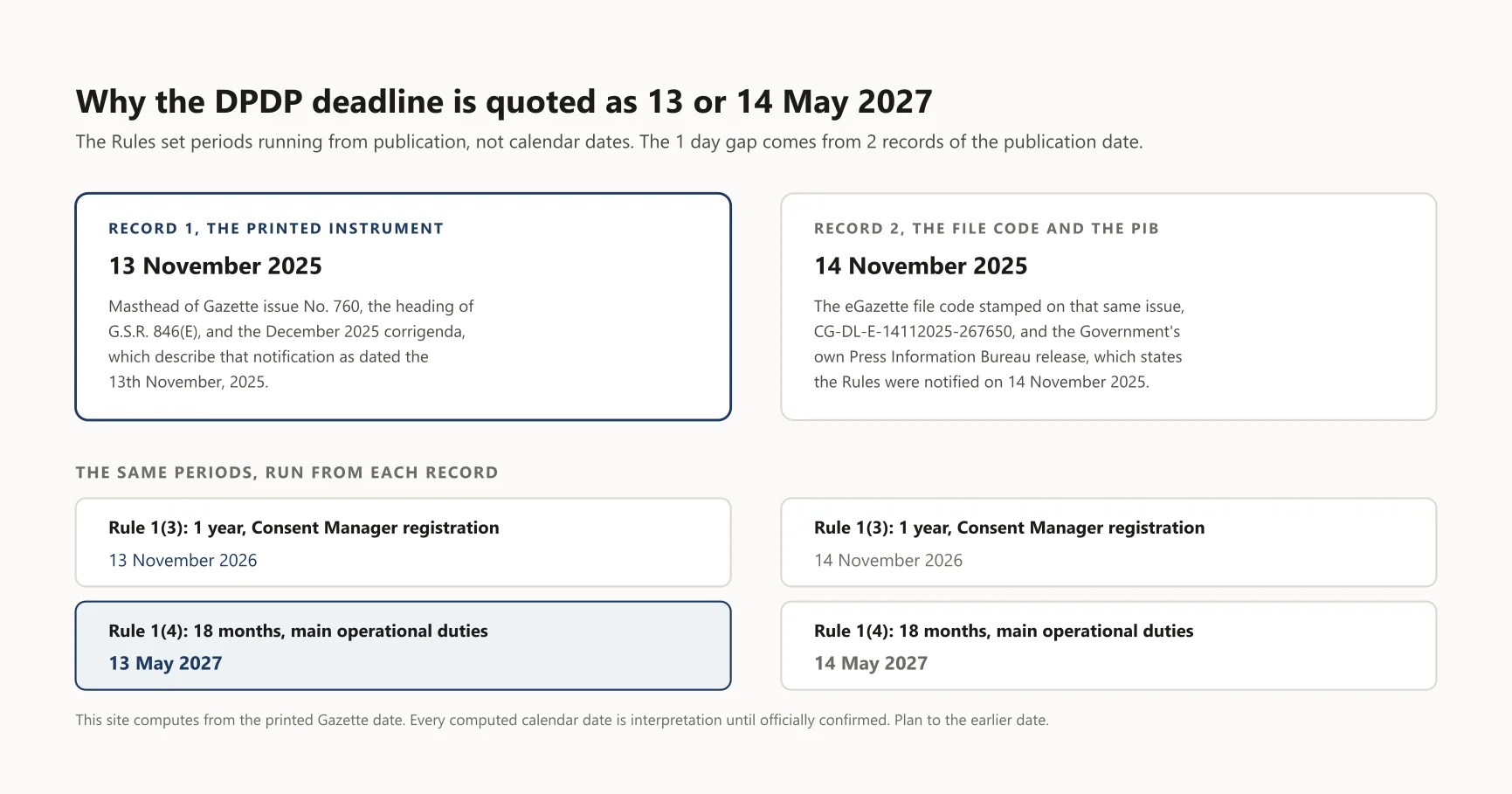
Search for the DPDP compliance deadline and you will find 2 answers. Some sources say 13 May 2027. Others say 14 May 2027. The same split runs through the earlier deadline: 13 or 14 November 2026 for Consent Manager registration.
Neither camp is inventing anything. The disagreement traces to a genuine ambiguity in how the notification date itself is recorded, and once you see it, the whole thing becomes simple to reason about.
The Rules never state a calendar date
This is the fact that most explainers skip. Rule 1 of the DPDP Rules 2025 does not say "these obligations begin on 13 May 2027". It sets periods that run from publication:
"Rules 1, 2 and 17 to 21 shall come into force on the date of their publication in the Official Gazette."
Sub rule (4), which carries the main operational duties, is printed differently and is quoted here inline rather than as an official requirement, because the closing words shown are the ones a corrigendum has since replaced: "Rules 3, 5 to 16, 22 and 23 shall come into force eighteen months after the date of publication of this Gazette." The operative reading is on Rule 1.
Corrigenda G.S.R. 892(E) of 10 December 2025 corrected the closing words of Rule 1(3) and Rule 1(4) to read "in the Official Gazette", so that is the operative wording today. The periods, 1 year and 18 months, were not touched, and no computed date moves. Those are 2 of the 8 corrections that corrigenda made, and its recital is itself a Government record of the notification date, describing G.S.R. 846(E) as "dated the 13th November, 2025".
The Act side commencement notification, G.S.R. 843(E), is drafted the same way, using "one year from the date of publication of this gazette" for the group containing section 6(9) and section 27(1)(d). No corrigendum on file amends that notification, so the Act side still reads "of this gazette" where Rule 1 now reads "in the Official Gazette".
So every calendar date you have ever seen for DPDP compliance is a computation, not a quotation. The computation needs an input the text does not supply: the date of publication. It also needs a convention for counting a period from that date, which the text does not state either. The publication date is where the 2 answers in circulation come from.
The publication date is recorded 2 ways
| Record | What it says | What it computes to |
|---|---|---|
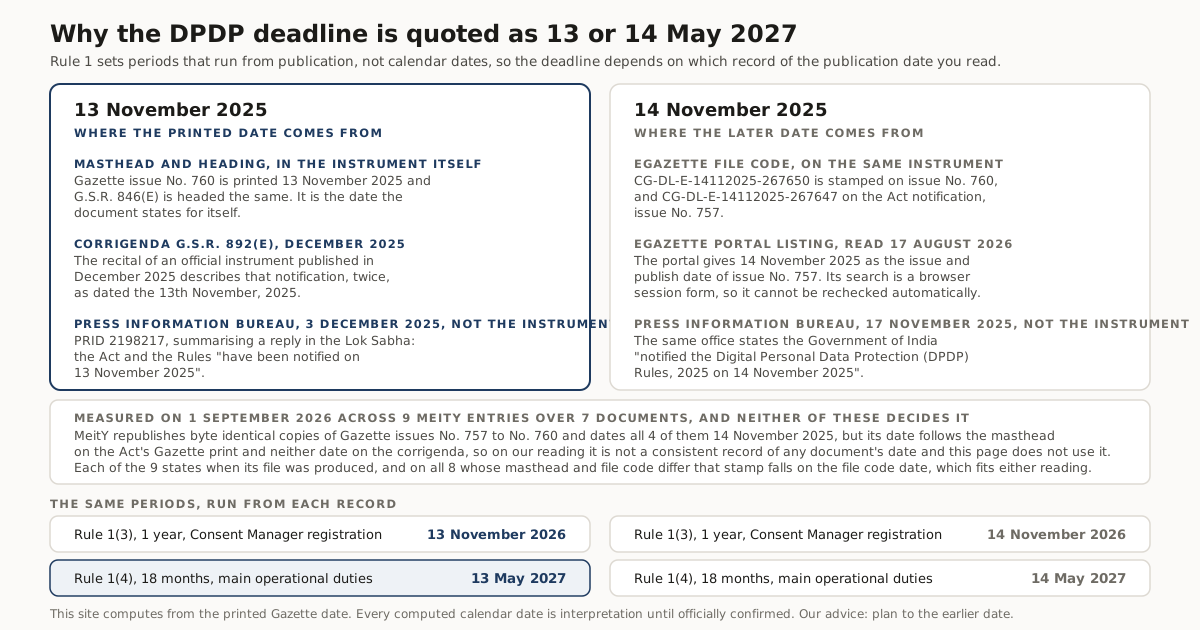
| Printed masthead of Gazette issue No. 760 | 13 November 2025 | 13 November 2026 and 13 May 2027 |
| eGazette file code printed on issue No. 760 itself, CG-DL-E-14112025-267650, and on the companion Act notification issue No. 757, CG-DL-E-14112025-267647 | 14 November 2025 | 14 November 2026 and 14 May 2027 |
| The eGazette portal's own listing for the companion Act notification, issue No. 757, as read on 17 August 2026 | 14 November 2025 as the issue and publish date | 14 November 2026 and 14 May 2027 |
| MeitY's own document library, which republishes byte identical copies of Gazette issues No. 757, No. 758, No. 759 and No. 760 | 14 November 2025 against all 4 | 14 November 2026 and 14 May 2027, subject to the next section, which tests this entry and finds it will not bear the weight |
| Press Information Bureau release of 17 November 2025 | "notified the Digital Personal Data Protection (DPDP) Rules, 2025 on 14 November 2025" | 14 November 2026 and 14 May 2027 |
| Press Information Bureau release of 3 December 2025, PRID 2198217, summarising a reply in the Lok Sabha | "The Digital Personal Data Protection Act, 2023 (DPDP Act), and the Digital Personal Data Protection Rules, 2025 have been notified on 13 November 2025" | 13 November 2026 and 13 May 2027 |
The 2 Press Information Bureau rows matter most, because they are the same office giving different dates 16 days apart. The 14 May 2027 figure is not a blogger's arithmetic error: it follows the Government's own published statement of 17 November 2025, and anyone who gives you 14 May 2027 is computing from a date the Government itself announced. But the later release, of 3 December 2025, summarising a reply given in the Lok Sabha, puts the Act and the Rules together on 13 November 2025. So "the Government's own date" is not one thing, and this cannot be settled by citing PIB against the masthead.
Equally, the date the instrument states for itself is 13 November 2025: it is on the masthead of issue No. 760, in the heading of G.S.R. 846(E), and repeated in the December 2025 corrigenda, which describe that notification as dated the 13th November, 2025. That is the date this site computes from, and it is why our pages say 13 May 2027.
MeitY's own library, and what its date is worth
There is a fourth record of the publication date, and it needs testing rather than citing. MeitY runs a document library of its own, separately from the eGazette portal, and it dates its copies of the November 2025 instruments 14 November 2025.
Taken at face value that is a second government host on the later date. The copies are not summaries or reprints, so the question is a fair one. On 1 September 2026 we downloaded every DPDP Gazette instrument in MeitY's library, at every entry that lists one on its own, and hashed each file against the copy this site already held. That is 9 entries over 7 documents: the Act's own Gazette print of August 2023, the draft Rules of January 2025, the 4 November 2025 instruments in Gazette issues No. 757 to No. 760, and the December corrigenda. Issue No. 758 and issue No. 806 each appear under 2 entry numbers, which is why 9 entries cover 7 documents. The only entry left out is a wrapper listing 5 files that are each measured individually.
All 9 matched byte for byte, so the ministry is serving the same files and its dates describe the same documents. 7 of those comparisons are against a copy obtained from the eGazette portal, which independently confirms that MeitY is serving the Gazette's own file. The other 2, the Act print and the draft Rules, are held from the same MeitY address the check re fetches, because no eGazette copy of either is on file: there, byte identity shows only that the file has not been replaced since we archived it.
Then look at what those dates do across the whole set. The Masthead date column below holds the date each masthead carries, written in this site's style rather than reproduced: every masthead in this set prints its date in the Gazette's bilingual format, Hindi then English, with the Saka date beside the Gregorian one. The eGazette file code column is the same kind of rendering, of the 8 digits inside the CG code printed on the issue itself.
| MeitY's entry | Masthead date | eGazette file code | MeitY's date follows |
|---|---|---|---|
| The Act's own Gazette print, issue No. 25 | 11 August 2023 | 12 August 2023 | the masthead |
| The draft Rules, issue No. 02 | 3 January 2025 | 3 January 2025 | both, since there is no split to resolve |
| The 4 November instruments, issues No. 757 to No. 760 | 13 November 2025 | 14 November 2025 | the file code |
| The corrigenda, issue No. 806 | 11 December 2025 | 12 December 2025 | neither. MeitY's index says 16 December 2025 and its posting date says 17 December, and the instrument's own notification heading says 10 December |
The first row is the one that matters, because it is the identical problem. The Act's Gazette print carries a masthead of 11 August 2023 and a file code embedding 12082023: exactly the 1 day split the November issues have. MeitY's catalogue records 11 August, the masthead. On the November issues the same catalogue records the file code date instead. On the corrigenda it records a date the instrument does not carry anywhere, and 2 of MeitY's own fields disagree with each other about which one that is, 16 December against 17 December.
There is an obvious objection to reading that as inconsistency, and it deserves an answer rather than silence. MeitY stores its document date in 2 different places depending on how an entry is filed, and the 2 rows whose date lands on the masthead are filed the same way, so the table could be comparing 2 fields that are each perfectly consistent in themselves. It is not. The corrigenda are filed both ways, and the copy filed in the same place as those 2 masthead rows carries 16 December 2025, which is neither the masthead nor the file code. So one field on its own gives the masthead on 1 document, both dates on a document that has no split, and neither on a third. The archived comparison prints the field name beside every row, so nobody has to take that from us.
MeitY's date is therefore not a consistent record of any of a document's own dates, and it cannot be cited as a government statement of a publication date, for 14 November or for 13 November. Our first reading of it was that it records when the ministry handled the file, and the draft Rules row refutes that too: MeitY posted them on 21 February 2025 from a February upload path and dated them 3 January 2025, the day they were printed. We do not know what the date records, MeitY publishes no note explaining it, and this page does not compute from it.
The same measurement turns up a fourth date, and it is worth reporting even though it decides nothing. Every one of these files states inside itself when it was produced. On all 8 whose masthead and file code differ, that production stamp falls on the file code date rather than the masthead: the corrigenda file produced on 12 December 2025 against a code embedding 12122025, the Rules file on 14 November 2025 against 14112025, the Act print on 12 August 2023 against 12082023. The 9th entry, the draft Rules, has no split at all and all 3 dates fall on the same day.
That pattern is consistent with the file code recording when the electronic file was made, which would favour the printed date. It is equally consistent with the making of the file being the electronic publication itself, which would favour the later one. It is real and it does not choose between those 2 readings, so we report it and do not lean on it. No official source on file says what the code records, and the 1 day question stays labelled interpretation until officially confirmed.
None of this is a claim you have to take from us. node scripts/meity-mirror-dates.mjs --check sources/reference/MeitY_gazette_mirror_dates_2026-09-01.txt re fetches MeitY's index and all 9 files, verifies the archive's own digest before trusting it as a baseline, and fails on any change to a recorded date, digest, field name or address.
One limit worth naming, because it bounds the section. This reaches MeitY's library and the files themselves. It does not reach the eGazette portal's own listing, which appears in the first table on this page and is a browser session form we cannot drive from here, so nothing here checks what that portal says about the corrigenda or about any issue other than No. 757.
What this actually means for planning
The honest answer is that the framework's own text gives you a period and the record of its start carries a 1 day ambiguity. That has 3 practical consequences.
- Plan to the earlier date. If your programme is built to be ready on 13 May 2027, the 1 day question never affects you. If it is built to land on 14 May 2027, you have made a 1 day ambiguity into a compliance risk for no benefit.
- Do not quote either date as settled law. Say "computed from the notification, approximately mid May 2027" in board papers, and cite the period rather than the date. The Rules state 18 months; that is the durable fact.
- Watch for an official confirmation. A clarificatory notification or corrigendum from MeitY, or a MeitY FAQ or press release stating the operative dates, would settle this. The Data Protection Board is not a route to it: as at 28 August 2026 it has no appointed members, a status tracked with its sources on whether the Board is operational, and the directions it will be able to give under section 27(1)(a) are urgent remedial or mitigation measures in the event of a personal data breach, not rulings on when a provision commenced. No such confirmation appears in the official sources on file, and none appears anywhere in MeitY's published document library, which was read end to end on 1 September 2026: 2,401 records, of which 28 name the framework and none is a clarification of these dates. The Press Information Bureau release of 3 December 2025 is the closest thing on file and it is not one: it restates a notification date inside a summary of a reply given in the Lok Sabha, without citing a provision or stating an operative deadline. So every calendar date on this site, including 13 May 2027 and 13 November 2026, is labelled interpretation until officially confirmed.
Why we chose the printed date
3 reasons, all about which document controls, and 1 piece of evidence that does not settle anything.
Leaving aside the 2 press releases already dealt with, 2 of the 4 remaining records sit on the same document. The masthead and the notification heading read 13 November 2025, while the file code stamped on the issue embeds 14112025. The other 2 sit outside the document altogether: the eGazette portal's own listing, which for the companion Act notification, issue No. 757, gives 14 November 2025 as the issue and publish date, and MeitY's document library, which dates its copies of all 4 November issues 14 November 2025 and, as shown above, is not a consistent record of any of a document's dates. We take the date the instrument states for itself, because it is the only one of the 4 that the document asserts as its own date, and because the corrigenda published in December 2025 refer back to the notification as dated the 13th November, 2025. No official source on file explains what the date inside the file code records, or what the date in MeitY's index records, so treat this choice as our interpretation rather than a settled rule about which record controls.
The file metadata is the one piece of evidence that could point either way, and we record it without resting on it. Of the DPDP Gazette files measured above, every one states its own production date internally, and on each of the 8 whose masthead and file code differ that stamp falls on the file code date. Read one way the code records when the electronic file was made, which favours the masthead. Read the other way the making of the file is the electronic publication, which favours the code. Nothing on file chooses between those readings, so this moves no computed date on the site.
Consistency also matters more than the individual choice. The Act side notification, Gazette issue No. 757, carries the same split: masthead 13 November 2025, CG code embedding 14112025. Computing the Act group and the Rules group from different bases would produce a timeline that contradicts itself. We take the printed date for both, and we say so on every page that shows a computed date.
The corrigenda issued on 10 December 2025 did reach Rule 1: items (i)(a) and (i)(b) change the closing words of Rule 1(3) and Rule 1(4) from "of this Gazette" to "in the Official Gazette". The 1 year and 18 month periods are unchanged, so no computed date moves. What the corrigenda do add is that an official instrument published in December 2025 twice describes G.S.R. 846(E) as dated the 13th November, 2025, which supports the printed date without settling the date of publication in terms.
The wider lesson about DPDP dates
If a source states a DPDP deadline without saying what it computed from, you cannot check it, and a 1 day gap between 2 sources usually traces to nothing more than the choice of publication date set out above.
The test to apply to any DPDP date you read: does the source name the period from the text, and does it name the publication date it used? If it does neither, it is repeating a number rather than reading the law.
What to do
Settle the dates that apply to your organisation with the compliance plan, which shows the commencement basis beside every action. For the current status of each provision, see what is in force today, and for the full chronology, the DPDP timeline. The original documents, including both Gazette issues and the corrigenda, are listed on the official documents page.
Related tool
Applicability Checker
Find out whether the DPDP framework likely applies to your organisation and processing.
Open
Related tool
Compliance Plan
Generate 1 company level action plan and see the work for your role first.
Open
What is in force today, provision by provision →The DPDP timeline, 2017 to 2027 →The official Gazette documents →