
DPDP Rules 2025 corrigendum G.S.R. 892(E): all 8 corrections
By Abhijeet Singh · Primary sources verified by dpdprules.orgPublished · Last reviewed 13 min read
What did corrigenda G.S.R. 892(E) change in the DPDP Rules 2025?
The short answer
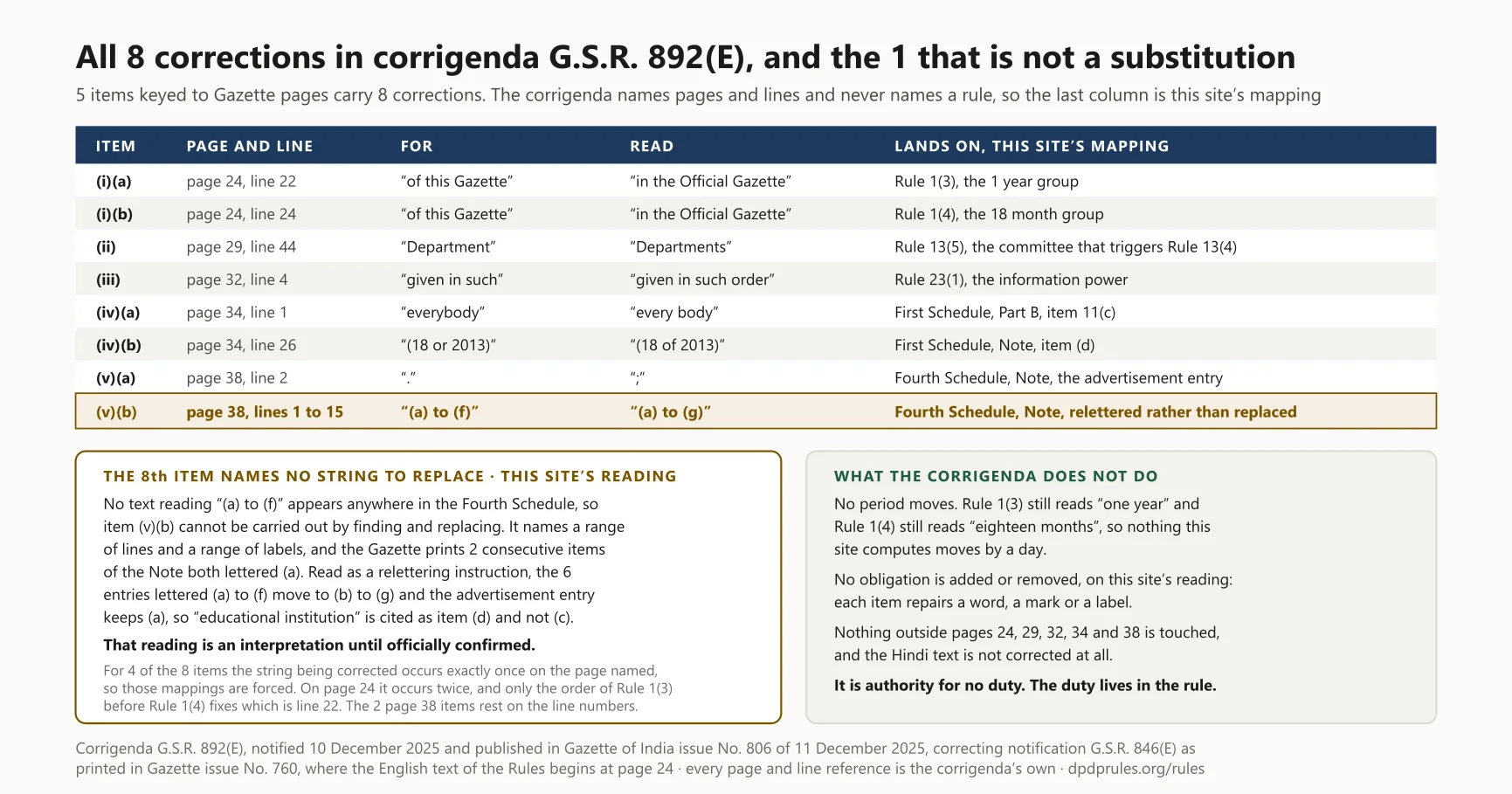
Corrigenda G.S.R. 892(E), notified 10 December 2025 and published in Gazette issue No. 806 of 11 December 2025, corrects notification G.S.R. 846(E) at 5 places: Gazette pages 24, 29, 32, 34 and 38. Those 5 items carry 8 separate corrections. The corrigenda names pages and lines and never names a rule; read against the Gazette print they land on Rule 1(3), Rule 1(4), Rule 13(5), Rule 23(1), the First Schedule and the Fourth Schedule. 7 of the 8 are substitutions, a named string replaced by another. The 8th, item (v)(b), names a range of lines and a range of labels rather than a string, and this site reads it as a renumbering instruction: the Fourth Schedule Note as printed lists 2 items lettered (a), and on that reading it runs (a) to (g) after the corrigenda, which is an interpretation until officially confirmed. No period in Rule 1 changes, and on the same reading no obligation is added or removed.
Corrigenda G.S.R. 892(E) is a single page. It was notified on 10 December 2025 and published in Gazette of India issue No. 806 of 11 December 2025, roughly 4 weeks after the DPDP Rules 2025 themselves. Its issue carries the same 1 day discrepancy the Rules issue does: the masthead reads 11 December 2025 and the eGazette file code stamped on it, CG-DL-E-12122025-268455, reads 12 December. It corrects notification G.S.R. 846(E) at 5 places, and those 5 places carry 8 separate corrections.
As at 28 August 2026 the corrigenda is widely referenced and rarely read out: a search returns overview pages, PDF hosts and a suggestion that you go and read it yourself. So here is every item, quoted, with the provision it lands on and what it does to the reading.
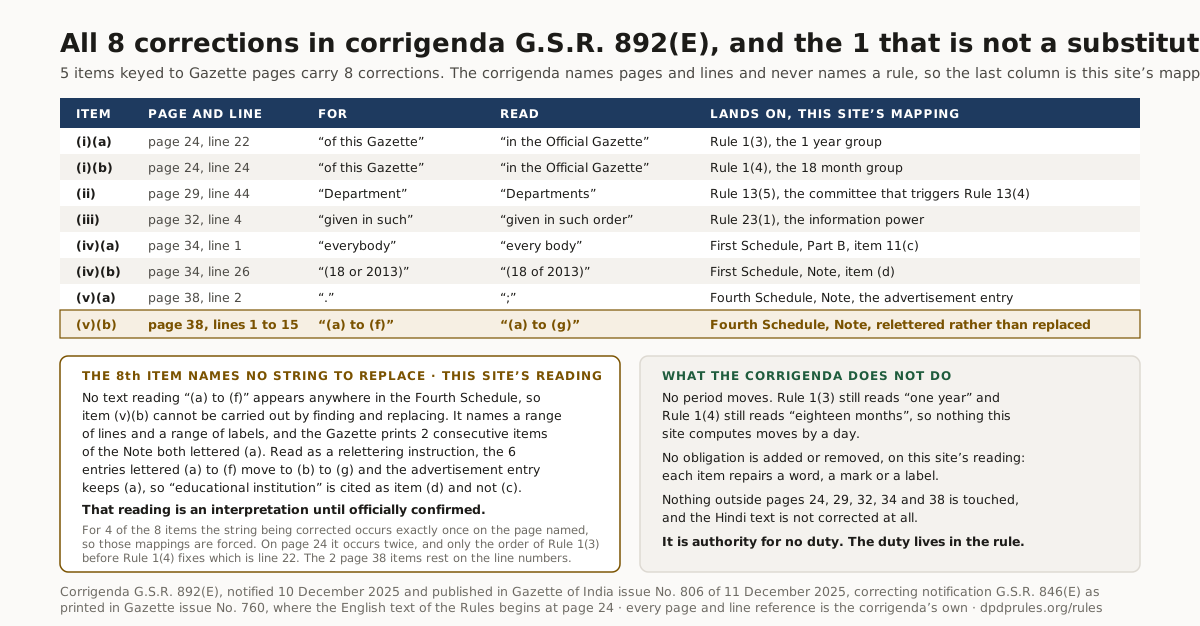
All 8 corrections
The corrigenda is organised as 5 roman numbered items keyed to Gazette pages. Items (i), (iv) and (v) each carry 2 corrections, which is where the count of 8 comes from.
| Item | Gazette page and line | For | Read | Lands on |
|---|---|---|---|---|
| (i)(a) | page 24, line 22 | of this Gazette | in the Official Gazette | Rule 1(3) |
| (i)(b) | page 24, line 24 | of this Gazette | in the Official Gazette | Rule 1(4) |
| (ii) | page 29, line 44 | Department | Departments | Rule 13(5) |
| (iii) | page 32, line 4 | given in such | given in such order | Rule 23(1) |
| (iv)(a) | page 34, line 1 | everybody | every body | First Schedule, Part B, item 11(c) |
| (iv)(b) | page 34, line 26 | (18 or 2013) | (18 of 2013) | First Schedule, Note, item (d) |
| (v)(a) | page 38, line 2 | . | ; | Fourth Schedule, Note |
| (v)(b) | page 38, lines 1 to 15 | (a) to (f) | (a) to (g) | Fourth Schedule, Note |
The page and line references are to notification G.S.R. 846(E) as printed in Gazette issue No. 760, where the English text of the Rules begins at page 24. Every mapping in the last column is this site's; the corrigenda names pages and lines and never names a rule.
For 4 of the 8 the string being corrected occurs exactly once on the page named, so the mapping is forced without counting lines at all: "Department" appears once on page 29, "given in such" once on page 32, and "everybody" and "(18 or 2013)" once each on page 34. 2 more are forced by order rather than by uniqueness: "of this Gazette" appears exactly twice on page 24, which leaves only the sequence of Rule 1(3) before Rule 1(4) to fix which of them is line 22 and which is line 24. The counts were taken on 6 September 2026 against the English section of the Gazette extraction. The 2 items on page 38 rest on the line numbers, and the corrigenda supplies its own check on how it counts: page 34 line 1 is "everybody", which is the first line of text under the running header, so the count excludes the header. That puts the advertisement definition on lines 1 to 2 of page 38, which is where item (v)(a) and the range in item (v)(b) point.
G.S.R. 892(E) does not say when its corrections take effect, and it does not recite the rule making power that G.S.R. 846(E) recites, section 40(1) and (2) of the Act; it is issued as corrigenda to a printed notification. This site therefore reads the corrected words as the words of G.S.R. 846(E) as notified, rather than as a change made on 11 December 2025. That is an interpretation until officially confirmed, and nothing here turns on it, because no item changes a period or an obligation.
The 2 commencement items, and what they do not do
Items (i)(a) and (i)(b) are the ones most likely to be misread as moving a deadline. They do not.
Rule 1 sets commencement by periods running from publication rather than by calendar dates. Sub rule (2) was printed correctly:
"Rules 1, 2 and 17 to 21 shall come into force on the date of their publication in the Official Gazette."
Sub rules (3) and (4) were printed with the closing words "of this Gazette" instead. The corrigenda makes all 3 read the same way. The 1 year period in Rule 1(3) and the 18 month period in Rule 1(4) are untouched, so nothing recomputes. Rule 1 is in force: it belongs to the group that commenced on publication, 13 November 2025.
What the correction does do is remove an argument. "Of this Gazette" points at a physical issue; "in the Official Gazette" points at the act of publication, and Rule 1(2) already used it. The Act side notification G.S.R. 843(E) is not consistent on this: its first limb reads "the date of publication of this notification in the Official Gazette", while the limbs setting the 1 year and 18 month periods read "the date of publication of this gazette", and no corrigendum on file changes them. Which of the 2 forms is better drafting is this site's view, not a finding of the corrigenda. The 1 day disagreement about whether the main DPDP deadline falls on 13 or 14 May 2027 survives the correction untouched, because that disagreement is about the date of publication and not about the words describing it. The 13 versus 14 November discrepancy is a separate question, and the recital of this corrigenda is one more Government record on the 13 November side: it describes G.S.R. 846(E) as "dated the 13th November, 2025".
The 3 items that repair a sentence
Item (ii) changes "Department" to "Departments" in the closing words of Rule 13(5). Rule 13(5) defines the "committee" whose recommendations let the Central Government specify personal data that a Significant Data Fiduciary may not transfer outside India under Rule 13(4). The corrected reading is "officials from other Ministries or Departments of the Central Government". Rule 13 is in the 18 month group and is not in force; on the printed Gazette date the group computes to 13 May 2027, which is an interpretation until officially confirmed.
Item (iii) is the largest repair of the 8. Rule 23(1) as printed ends in mid air: the Central Government may require a Data Fiduciary or intermediary to furnish information "within the specified period as may be given in such". Given in such what? The corrigenda supplies the missing noun: "given in such order". That is not only grammar. It tells you the instrument by which the period is fixed is an order. What follows from that, that a Data Fiduciary has to receive the order before any period can start running, is a reading of the corrected sub rule and not something either instrument says. Rule 23 is also in the 18 month group.
Item (iv)(a) changes "everybody" to "every body" in item 11(c) of Part B of the First Schedule, the Consent Manager's public disclosure obligation. This one reads like a spacing typo and is not. The Note to the same Schedule defines the expression:
"the expression “body corporate” shall include a company, a body corporate as defined under clause (11) of section 2 of the Companies Act, 2013 (18 of 2013), a firm, a financial institution, a scheduled bank or a public sector enterprise established or constituted by or under any Central Act, Provincial Act or State Act, and any other incorporated association of persons or body of individuals;"
"Everybody corporate" is not that defined expression and is not any expression. "Every body corporate" picks up the definition, and with it firms, financial institutions, scheduled banks and public sector enterprises, which a Consent Manager must disclose wherever a promoter, director, key managerial personnel or senior management holds shares in excess of 2 per cent as on the first day of the preceding calendar month. The First Schedule is served by Rule 4 and this site presents it as commencing when Rule 4 does, because Rule 1 names rules and not Schedules. Rule 4 is in the 1 year group: on the printed Gazette date that computes to 13 November 2026, interpretation until officially confirmed.
Item (iv)(b) changes "(18 or 2013)" to "(18 of 2013)" in item (d) of the Note to the First Schedule. The First Schedule cites the Companies Act, 2013 in 3 places: items (a), (b) and (d) of the Note. Items (a) and (b) were printed "(18 of 2013)". Item (d), the one attaching to the expressions "promoter" and "senior management", was printed "(18 or 2013)". The corrigenda makes item (d) match the other 2.
The 8th item is not a substitution, and that is the whole story of the Fourth Schedule
7 of the 8 corrections take a string and replace it. Item (v)(b) does not, and reading it as though it did is how the Fourth Schedule Note gets misquoted.
Here is how the Note opens in Gazette No. 760. It is quoted inline rather than set as an official requirement, because these are the exact words the corrigenda then corrects, and the operative reading is the corrected one on the Fourth Schedule page:
"(a) “advertisement” shall have the same meaning as is assigned to it in the Consumer Protection Act, 2019 (35 of 2019). (a) “allied healthcare professional” shall have the same meaning as is assigned to it in the clause (d) of section 2 of the National Commission for Allied and Healthcare Professions Act, 2021 (14 of 2021);"
2 consecutive items, both lettered (a). The first ends with a full stop, as though the Note were over after 1 definition, and then a second list starts again at (a) and runs to (f).
Item (v)(a) fixes the full stop: in page 38, line 2, for ".", read ";". That turns the advertisement entry into the first item of a list that keeps going instead of a sentence that stops.
Item (v)(b) then reads: lines 1 to 15, for "(a) to (f)", read "(a) to (g)".
There is no text reading "(a) to (f)" anywhere in the Fourth Schedule to find and replace. What the item names is a range of lines, 1 to 15 of page 38, and a range of labels. It is an instruction about how the list is lettered, and the range beginning at line 1 is what shows the relettering reaches the first definition rather than only the second list. The 6 entries that were lettered (a) to (f) move to (b) to (g), and the advertisement entry keeps (a).
| Definition | As printed | Label after the relettering, on this site's reading |
|---|---|---|
| advertisement | (a) | (a) |
| allied healthcare professional | (a) | (b) |
| clinical establishment | (b) | (c) |
| educational institution | (c) | (d) |
| healthcare professional | (d) | (e) |
| health services | (e) | (f) |
| mental health establishment | (f) | (g) |
Read as a substitution, item (v)(b) has no target and does nothing, and the Note is left with a duplicate label in a definition list. Read as a renumbering instruction, it is the item that makes the Note internally consistent, and it changes how every one of those definitions is cited. "Educational institution" is item (d) of the Note, not item (c), and that is the definition that scopes entry 3 of Part A, the exemption schools rely on.
This site publishes both texts. The Fourth Schedule page prints the corrected wording under a caption that says it is the print with G.S.R. 892(E) applied rather than the words of any single page, and keeps the Gazette's own text behind a disclosure, because the relettered labels are a reconstruction the corrigenda compels rather than states. The same treatment is on Rule 1, Rule 13, Rule 23 and the First Schedule.
What the corrigenda did not change
It is worth being explicit, because a correction notice invites the assumption that something moved.
- No date moves. Rule 1(3) still reads "one year" and Rule 1(4) still reads "eighteen months", the corrigenda touches neither, and nothing this site computes changes. That the correction has no effect on the periods is a reading of the items; G.S.R. 892(E) says nothing about the effect of anything it does. The Act side commencement notification G.S.R. 843(E) is a different instrument that this corrigenda does not reach at all.
- No obligation is added or removed, on this site's reading. Each item repairs a word, a mark or a label rather than a duty, so the Consent Manager disclosure duty, the Rule 13(4) localisation restriction, the Rule 23 information power and the Fourth Schedule exemptions read on the same facts after the correction as before it. Item (iv)(a) is the one to watch: "every body corporate" picks up the defined expression where "everybody corporate" did not, so on this reading the correction settles the reach of that disclosure item rather than enlarging it.
- Nothing outside pages 24, 29, 32, 34 and 38 is touched. Rule 3 on notice content, Rule 6 on security safeguards, Rule 7 on breach intimation, Rule 8 on retention and the Third Schedule are all as first printed.
- The Hindi text of the Rules is not corrected by this instrument. G.S.R. 892(E) names page and line numbers in the English section only.
How to cite the Rules now
If you are drafting a policy, a contract clause or a notice that cites the DPDP Rules 2025, 3 practical points follow.
Cite Rule 1(3) and Rule 1(4) with the corrected closing words, and say so. The uncorrected text is still what the Gazette page shows, so a reader checking you against the PDF will find a difference unless you name the corrigenda.
Cite the Fourth Schedule Note by the corrected letters, and name the corrigenda in the same breath. Anyone reading the printed Schedule will find "educational institution" at (c) and will need to know why you have it at (d).
Do not cite G.S.R. 892(E) as authority for any duty. It creates none. The requirement always lives in the corrected rule, which is the only place a duty can be read from.
Fourth Schedule, printed text and corrected text →Rule 1, commencement of the DPDP Rules →The official Gazette documents →