
DPDP grievance redressal: what Rule 14(3) says about 90 days
By Abhijeet Singh · Primary sources verified by dpdprules.orgPublished · Last reviewed 5 min read
How does grievance redressal work under the DPDP framework?
The short answer
Once section 13 is in force, the Act gives every Data Principal a right to readily available grievance redressal from the Data Fiduciary or Consent Manager, and requires the grievance channel to be exhausted before approaching the Data Protection Board. Rule 14(3) is the only place a period appears in the rights and grievance rules, 90 days, and as printed the sentence has no object for "publish", so what the words "not exceeding ninety days" cap is not stated. 2 readings are open: that they cap the response period the fiduciary must publish, or that they are a time limit on the publishing itself. This site takes the first, because the second half of the same sub rule then uses "such period" for responding, which the earlier words can only supply if they are a response period; that is this site's reading and not what the text states. Section 13 and Rule 14 are both in the 18 month commencement group, computed at 13 May 2027 and interpretation until officially confirmed.
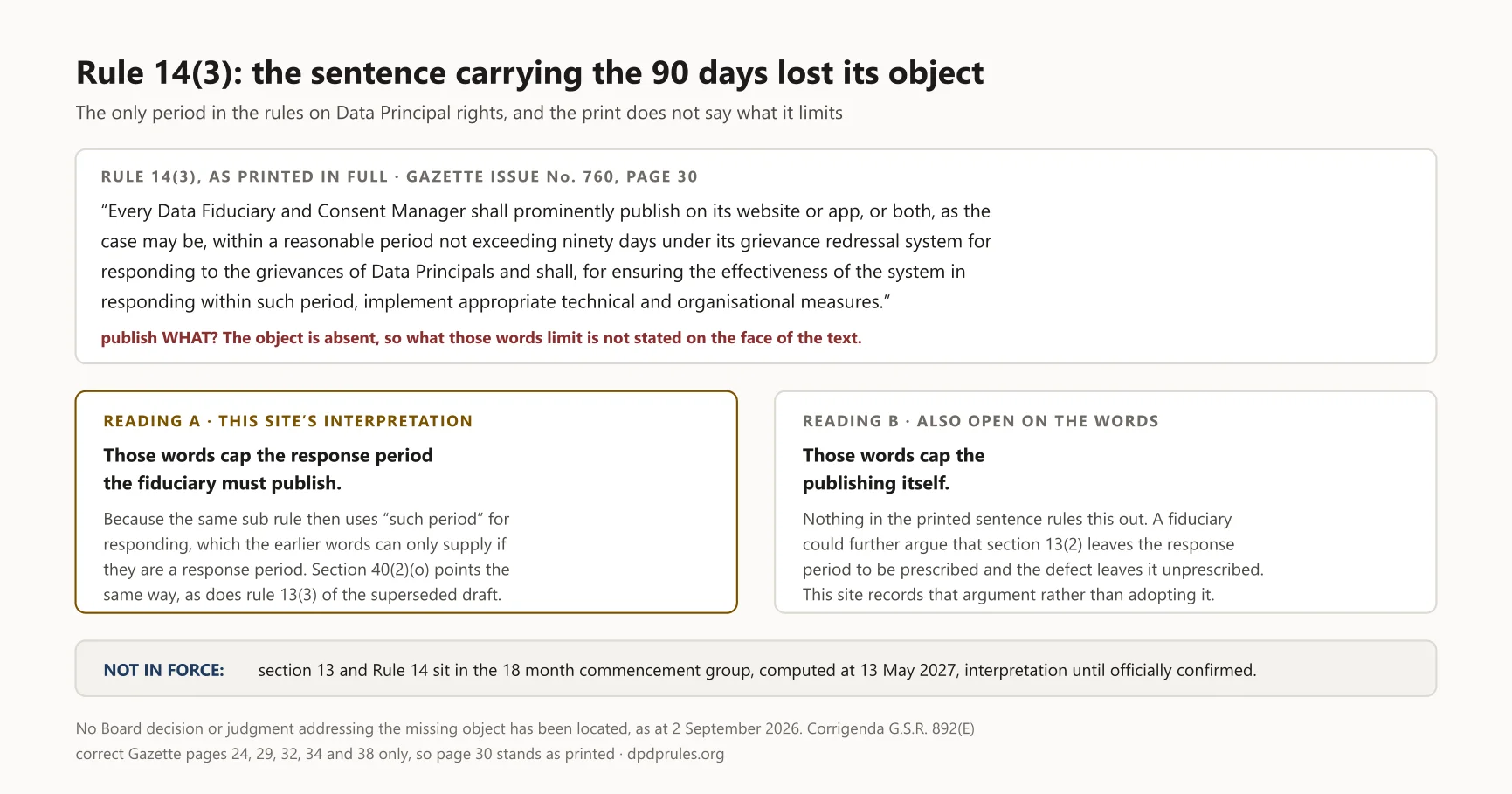
Grievance handling is where individual rights and company operations meet, and it is the only right in Chapter III with a number attached to it. That number is in Rule 14(3), in a sentence the Gazette printed with a piece missing. None of it is in force yet: section 13 and Rule 14 both sit in the 18 month group, computed at 13 May 2027 and interpretation until officially confirmed.
The right, and the sequence
Section 13 gives the Data Principal a right to readily available means of grievance redressal from the Data Fiduciary or Consent Manager, covering any act or omission about its data obligations or the exercise of rights. And it fixes the sequence:
"The Data Principal shall exhaust the opportunity of redressing her grievance under this section before approaching the Board."
Section 17(1) removes the whole of Chapter III, including this right, in the 6 cases it lists, so nothing here is unconditional.
For organisations this cuts both ways. Your grievance channel is the mandatory first stop, which means its quality determines whether disputes escalate. A channel that stalls is an invitation to the Board.
The 90 days, and the sentence that lost its object
Rule 14(3) is the only place a period appears in this area, and the sentence that carries it lost its object at notification. As printed it requires a fiduciary or Consent Manager to "prominently publish ... within a reasonable period not exceeding ninety days under its grievance redressal system for responding to the grievances of Data Principals", so the sentence has no object for "publish" and 2 readings are open: that the 90 days caps the response period the fiduciary must publish, or that it is a time limit on the publishing itself. This site takes the first, for 2 reasons. The second half of the same sub rule requires measures "for ensuring the effectiveness of the system in responding within such period", and the sub rule then uses "such period" for responding, which the earlier words can only supply if they are a response period. And section 40(2)(o), the rule making entry under which a period may be prescribed for section 13(2), describes it as "the period within which the Data Fiduciary shall respond to any grievances". That is this site's reading, not what the printed sentence states. Draft rule 13(3) of the January 2025 draft had the missing object, reading "publish ... the period under its grievance redressal system", which is why this site reads the dropped words as the period; that reading is ours. Corrigenda G.S.R. 892(E) correct Gazette pages 24, 29, 32, 34 and 38 only, so page 30 stands as printed and the defect has not been repaired. Because section 13(2) leaves the response period to be prescribed, a fiduciary could argue the defect leaves it unprescribed. That is an argument this site records rather than adopts, and no Board decision or judgment addressing it has been located, as at 2 September 2026. The duty to prominently publish is on the face of the sub rule and the words "not exceeding ninety days" are verbatim; what is missing is the thing to be published. Until that is corrected or construed, publishing a response period you can actually meet, and meeting it, is a recommendation this site makes rather than a requirement the printed text spells out.
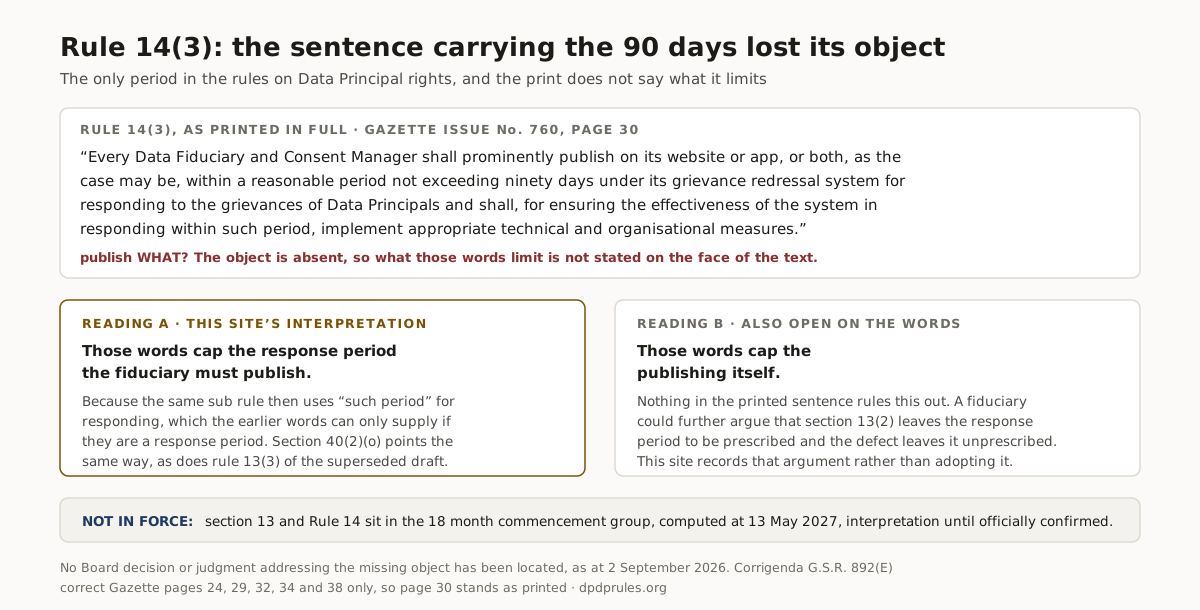
What to build
A named intake channel, an owner, a clock that starts on receipt, and templates for the common cases. Individuals exercising rights get pointed here when requests fail, so the grievance system is effectively the appeals layer of your whole rights machinery.
What to do
Individuals: the rights assistant walks the sequence, and Data Principal rights under the DPDP Act sets out each right beside its section. Organisations: the grievance system is an action in the company plan, with the official texts at Section 13 and Rule 14.