
Does the DPDP Act apply to government departments?
By Abhijeet Singh · Primary sources verified by dpdprules.orgPublished · Last reviewed 9 min read
Jump to sourcesDoes the DPDP Act apply to government departments?
The short answer
Yes. Section 2(s)(vi) includes the State in the Act's definition of person, so a department that determines the purpose and means of processing can be a Data Fiduciary for that activity. This is not a blanket rule that every government system is covered in the same way: first check section 3 scope, then identify the processing ground. Section 7(b) covers specified State services, benefits, certificates, licences and permits when its conditions and the Second Schedule standards are met. Section 7(c) covers State functions under law and listed sovereign or security interests. Once section 17 commences, subsection (4) will give narrow automatic relief from named erasure, correction, completion and updating duties. Section 17(2)(a) is different and will require a Central Government notification covering the instrumentality and listed public interests. Sections 3 to 5, section 6 apart from section 6(9), sections 7 to 17, and Rules 3 and 5 to 16 sit in 18 month groups. The computed 13 May 2027 remains an interpretation of the operative instruments because they state a period; PIB release 2336151 reports the same scheduled date.

Status as at 24 November 2026: section 2 and section 6(9) are in force; the main duties shown remain in 18 month groups. Derived 13 May 2027 remains an interpretation of the operative instruments because they state periods; PIB release 2336151 reports the same scheduled date.
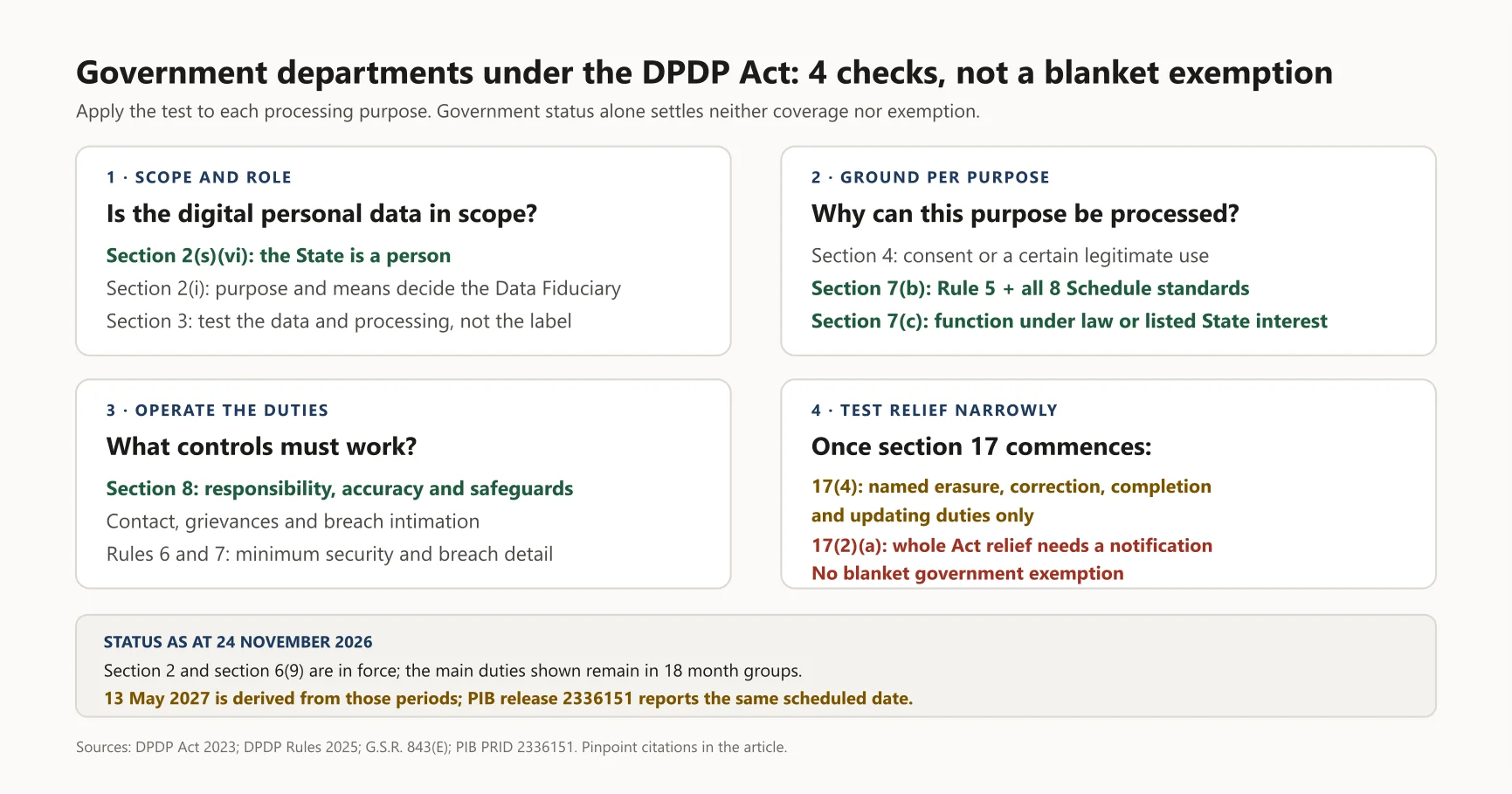
Government does not sit outside the DPDP Act by default. The Act includes the State in its definition of a person, then gives State processing specific grounds, standards and exemptions. The right starting point is therefore the processing activity, not the label on the organisation.
The short answer: covered can be the default, exempt is not
Section 2(s)(vi) includes "the State" in the definition of person, and section 2(zb) adopts the article 12 meaning of State. Section 2(i) then asks a functional question: who determines the purpose and means of processing personal data?
Read together, a department, local body, board, commission or other public body can be a Data Fiduciary for a processing activity it controls. The label public authority does not itself answer the question, and the Act does not use 1 organisation wide role. A department can determine a purpose for one database while a shared government technology body or vendor processes another data flow on its behalf.
Section 3 remains the first gate. The Act reaches digital personal data collected digitally and personal data collected non digitally and digitised later. A paper file that never becomes digital does not enter through section 3(a), while a scanned register can. The 2 section 3(c) exclusions still need to be checked, but neither is a general exclusion for government.
A public purpose is not enough: record the section 4 ground
Once the processing is in scope, section 4 requires a lawful purpose and 1 of 2 routes: consent or a certain legitimate use in section 7. Calling an activity a public service, welfare programme or statutory function does not replace that mapping.
| Government processing pattern | Possible route | What must be checked |
|---|---|---|
| A citizen chooses a service and gives valid consent | Sections 5 and 6 | The notice, consent standard, withdrawal route and proof of consent |
| A prescribed subsidy, benefit, service, certificate, licence or permit | Section 7(b), Rule 5 and Second Schedule | Which limb of section 7(b) applies, whether its record and notification conditions are met, and all 8 Schedule standards |
| A function under Indian law | Section 7(c) | The exact law and function, not only a general public interest statement |
| Sovereignty, integrity or security of the State | Section 7(c) | Whether the processing purpose actually falls within the listed interest |
| An emergency, public health event or disaster | Sections 7(f) to 7(h) | The facts and the limits of the particular clause |
| Government as an employer | Section 7(i) | Whether the purpose falls within the employment or loss prevention wording |
The map should be kept per purpose. A land department may hold ownership data for a statutory register, employee data for administration, visitor data for building security and phone numbers for alerts. The same database can contain records used under different grounds. A single label such as official use is not the legal analysis.
Section 7(b): services and benefits carry their own standards
Section 7(b) is narrower than a general government processing clause. It concerns provision or issuance of a subsidy, benefit, service, certificate, licence or permit. Clause (i) starts from previous consent for one of those categories. Clause (ii) instead points to data in a State database, register, book or other document, but adds its own notification and standards conditions.
Rule 5 sends this processing to the Second Schedule. The Schedule requires:
- lawful processing;
- use only for the section 7(b) use;
- only the personal data necessary for that use;
- reasonable efforts on completeness, accuracy and consistency;
- retention only while needed for the use or another law;
- reasonable security safeguards;
- an intimation, contact person and route to exercise rights, plus other applicable standards under Central Government policy or law; and
- accountability of the person deciding purpose and means.
That is a purpose and control framework, not an invitation to reuse every field already held by government. A department preparing a cross scheme eligibility check should document the precise service or benefit, the section 7(b) limb, the record source, every data field needed and the Schedule control that makes the step operational.
Section 7(c): tie the processing to the law or listed interest
Section 7(c) covers performance by the State or its instrumentalities of a function under Indian law. It separately covers processing in the interest of sovereignty and integrity of India or security of the State.
For an ordinary statutory function, the useful implementation record is simple: name the enactment, rule, notification or order that creates the function; identify the purpose; list the necessary data; name the department that decides the purpose and means; and record every system and vendor that processes on its behalf. This is a recommendation for proving the mapping, not a form prescribed by the Act.
Do not stretch the security words across routine administration. The clause lists them as particular interests. If the legal function limb already fits, using its exact legal basis produces a clearer and more reviewable record.
What remains for a government Data Fiduciary
Section 8 does not create a reduced general duty set for departments. Subject to the precise exemptions below, its operational areas include:
- responsibility for processing by the Data Fiduciary or on its behalf;
- completeness, accuracy and consistency where data is likely to be used for a decision affecting the individual or disclosed to another Data Fiduciary;
- appropriate technical and organisational measures;
- reasonable security safeguards;
- personal data breach intimation;
- publication of a contact who can answer processing questions; and
- an effective grievance mechanism.
Rule 6 turns reasonable security safeguards into a minimum control set covering protection methods, access control, logs and monitoring, continuity, 1 year retention of such logs and personal data, processor contracts where applicable, and technical and organisational measures. Rule 7 sets the breach communications: affected individuals without delay and a staged Board intimation, with detailed information within 72 hours unless the Board permits longer.
Rights need their own provision by provision map. Sections 11 and 12 contain wording tied to prior consent, while sections 13 and 14 do not use that same gate. The Second Schedule also tells a section 7(b) fiduciary to give a route through which the individual may exercise rights under the Act. The individual rights guide keeps that unresolved interaction visible rather than pretending every right has identical reach.
Section 17 gives limited relief, not government immunity
Two State provisions are often collapsed into one. They do different work.
Once section 17 commences, subsection (4) will operate without a notification. For processing by the State or an instrumentality, it will disapply the erasure duty in section 8(7) and the answering erasure duty in section 12(3). It will also disapply the correction, completion and updating duty in section 12(2) where the purpose does not include making a decision that affects the Data Principal. It will not switch off section 8 security, breach, contact or grievance duties.
Section 17(2)(a) depends on a notification. It can disapply the whole Act for processing by a State instrumentality that the Central Government notifies on the listed sovereignty, security, foreign relations, public order or offence related grounds. It also reaches the related Central Government processing the clause describes. A department cannot infer this whole Act exemption merely from being governmental or from handling sensitive work.
Other parts of section 17 are processing specific too. Courts, regulators, offence investigation, offshore contracts, approved restructuring and loan default each have their own text. The section 17 guide shows what each route switches off and what survives.
What the current government records show
A Press Information Bureau release of 16 May 2026 reports a national workshop on strengthening cybersecurity frameworks for State data. It reports the Secretary, MeitY, as noting that the Act becomes fully enforceable from 13 May 2027. A later PIB release of 14 November 2026 reports the same date for the main rights, duties, inquiry and penalty phase. Those statements corroborate the calendar date this site computes, but neither release is the operative instrument. G.S.R. 843(E) and Rule 1 state 18 month periods rather than that calendar date, so 13 May 2027 remains an interpretation of the operative instruments.
The same release lists a State cyber security policy, an empowered CISO, a State SOC and a Cyber Crisis Management Plan as 4 foundational requirements in the wider MeitY programme. Those are policy expectations in a cybersecurity workshop, not 4 duties written into the DPDP Act. Departments may need them under other directions, but this article does not rebrand them as DPDP requirements.
The GNCTD Information Technology Department issued a separate circular dated 26 May 2026. It requested its departments and organisations to undertake necessary compliance measures and said departments may review applications, portals, databases, business processes and contracts. That is a useful readiness pattern and an administrative readiness circular within GNCTD. It is not a national rule and does not change the section 4, 7 or 17 tests.
A practical readiness sequence before May 2027
The following is an implementation recommendation, not a statutory form:
- Inventory every application, portal, database, register that becomes digital, shared service and vendor flow involving identifiable individuals.
- Assign the person deciding the purpose and means for each flow. Record processors and any other independent Data Fiduciary separately.
- Give every purpose a section 4 ground. For State services, test section 7(b) and all Second Schedule conditions. For legal functions, cite the exact section 7(c) law and function.
- Reduce each flow to necessary fields and record the source, recipient, retention basis and decision made with the data.
- Build the section 8 operating controls: accuracy checks for decisions and disclosures, security, processor action, breach response, contact publication and grievances.
- Map rights by provision and by ground. Do not assume section 17(4) removes the right simply because it removes a named answering duty.
- Keep an exemption register. Record the exact subsection, processing activity, conditions and notification if one is required. Never use government department as the exemption reason.
- Test the process with 1 real citizen journey and 1 breach simulation before the operational phase.
Use the applicability checker for the section 3 gate, then put each processing activity into the company compliance plan. The tool name is generic, but its control map can be used by a department once the legal ground and any State specific relief have been identified.
Related tool
Applicability Checker
Find out whether the DPDP framework likely applies to your organisation and processing.
Open
Related tool
Compliance Plan
Generate 1 company level action plan and see the work for your role first.
Open
Related tool
Data Breach Response Playbook
Rule 7 is not in force yet, so plan its breach steps now, including the detailed submission to the Board within 72 hours unless it allows longer on a written request, against the exact requirements.
Open
Section 2 definitions, official text →Section 7 certain legitimate uses, official text →Section 17 exemptions, official text →Rule 5 for State services, official text →Second Schedule standards, official text →What section 17 actually switches off →What is in force now →
Government departmentsState processingSection 7Section 17Public authorities